

The destinations winning the next decade aren't the ones with the best attractions. They're the ones that built the infrastructure to know their visitors and turned that knowledge into a revenue generating, self funding platform that boards, sponsors, and legislators can see working in real time.
Every year, destinations commission economic impact studies, compile lodging tax receipts, and report visitor counts to their boards and state legislatures. The Tourism Economics model runs. The numbers land in an annual report. The funding cycle continues. This is not analysis. It is accounting after the fact, and it is the dominant mode of destination intelligence in the United States today.
Meanwhile, the visitor who arrived at the welcome center, asked about restaurants, booked a kayak tour, checked into the hotel, ate at three local establishments, and attended a festival on Saturday generated dozens of behavioral signals that the destination will never see. That visitor's path through the economy, where they spent, what they responded to, which experiences drove incremental activity, exists as a series of disconnected transactions in systems that don't talk to each other and data that belongs to platforms, not places.
The consequence is structural: DMOs advocate for budget with lagging aggregates. They pitch sponsors with estimates. They defend their value with models. And they lose influence precisely when they should be gaining it, in an era where every dollar of public investment in economic development is being scrutinized more carefully than at any point in memory.
The DMOs that will thrive in the next decade are not the ones with the best annual report. They are the ones that have built the infrastructure to know in real time, with attribution, from first party data what their destination is doing to visitors and what visitors are doing to the local economy.
Visitor intelligence is a destination wide operating system for understanding, engaging, and converting visitor behavior into measurable economic activity. The kiosk and mobile conversation and the intelligence conversation look superficially similar but lead to entirely different institutional outcomes.
When a destination can show, from first party behavioral data, that visitors who engage with a recommendation platform spend 23% more at local restaurants, stay 0.8 nights longer, and return at twice the rate of walk in visitors, that is not a visitor service story. That is an economic development story. That is a sponsor ROI story. That is a legislative appropriation story. And it is only possible if the destination has built the infrastructure to capture the signal at the point of engagement and connect it to the economic outcome downstream.
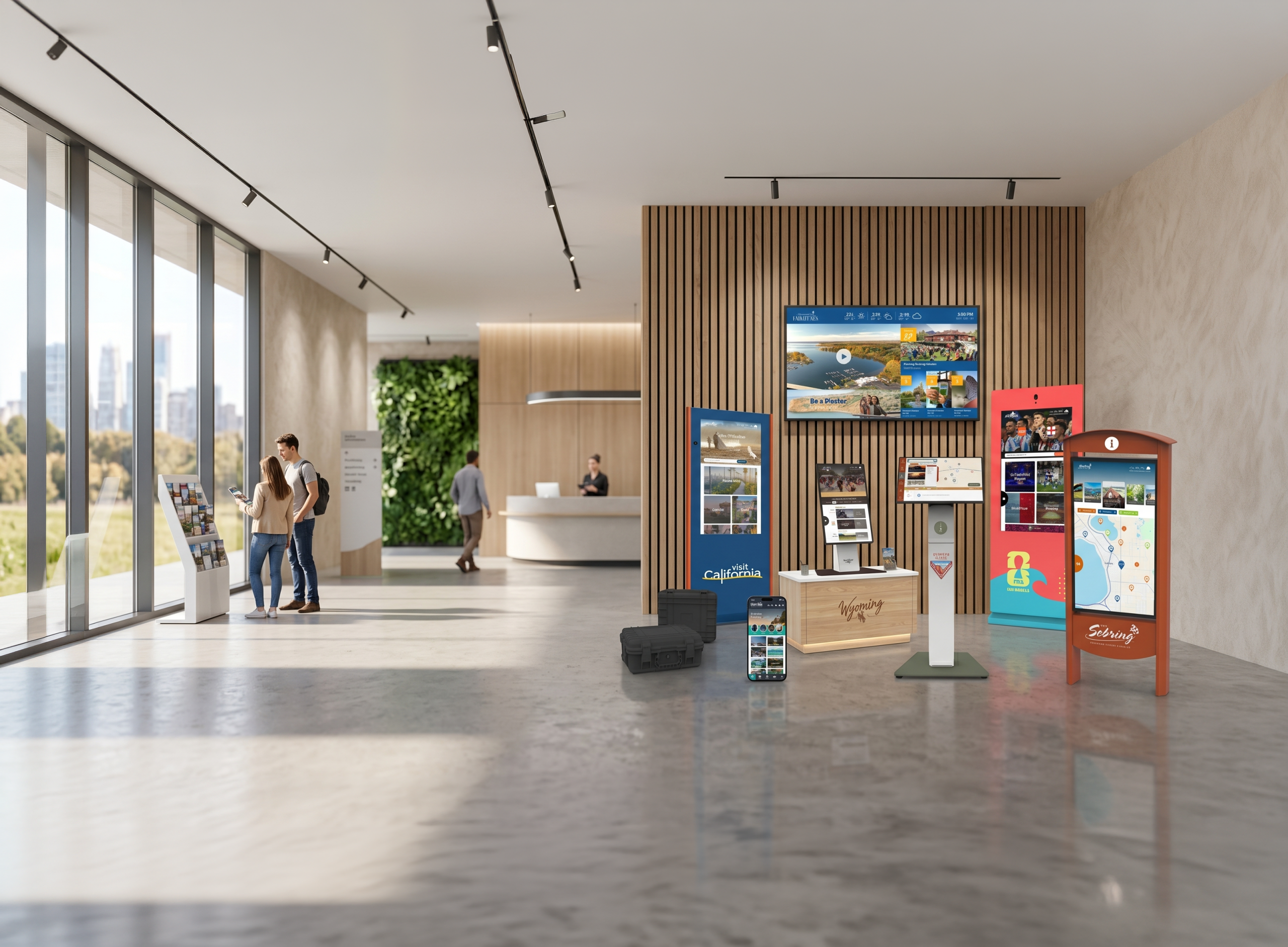
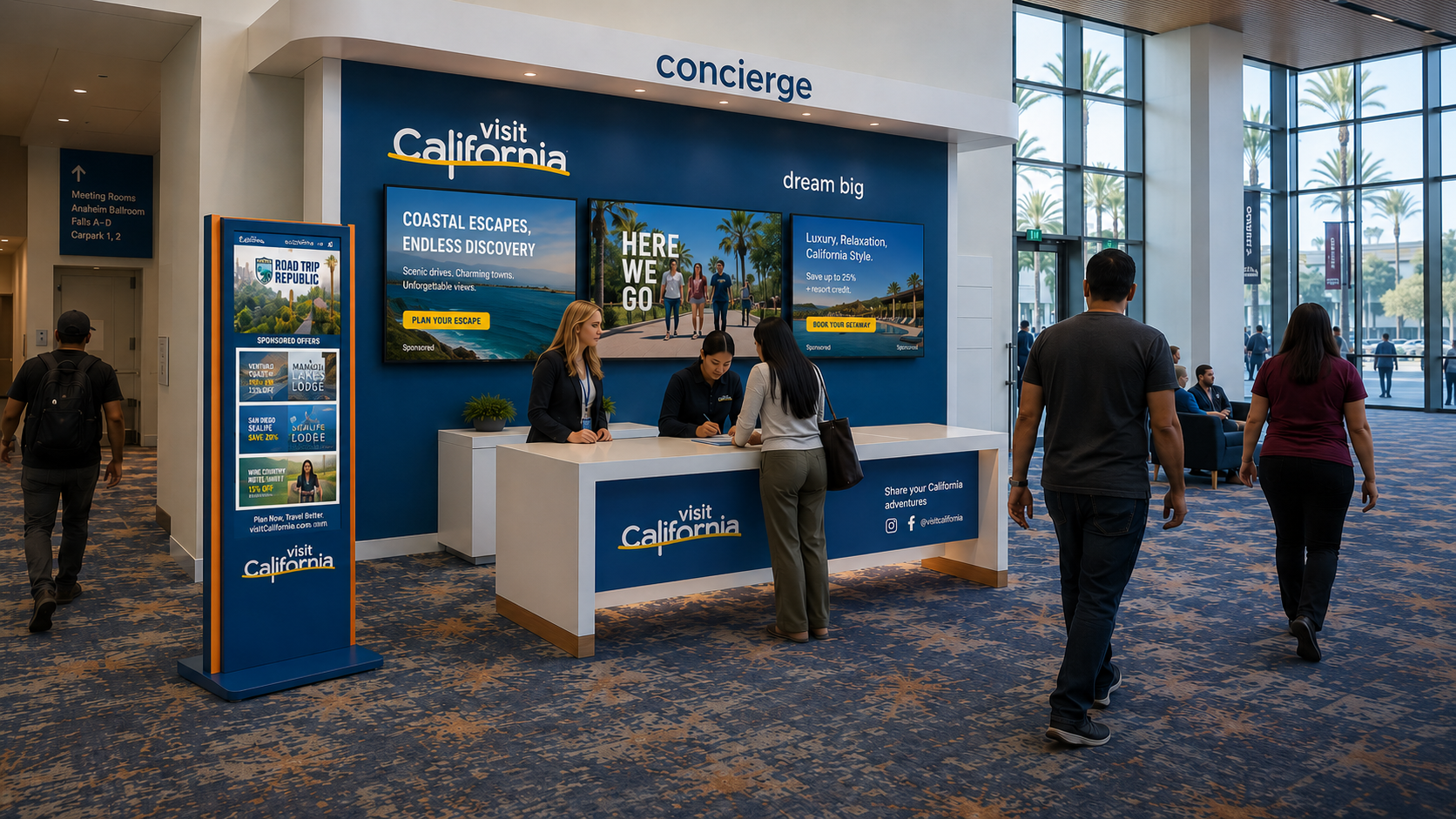
Connected screens, voice enabled kiosks, and mobile entry points turn every welcome center, airport, and event interaction into owned, attributed data, the moment a visitor engages.
The opportunity is not to replace existing platforms. Tourism Economics, STIR, Zartico, Adara, and the other intelligence tools DMOs rely on provide essential macroeconomic context: regional impact models, lodging performance benchmarking, competitive set analysis, aggregate visitor origin data. Those tools answer the "how much" question at the destination level.
What they cannot answer is the behavioral question at the individual engagement level: which visitor, doing what, where, generating how much for which business, and why. That signal lives at the point of contact, and it is the signal that most destinations are not capturing.
TrueOmni connects to the existing intelligence stack as the behavioral layer, the source of ground truth data that gives macro models a real world foundation and gives DMO leadership the first party attribution their sponsors and legislators actually want to see.
The destination that owns its visitor data owns a media network. That network is not a side project. It is the ecosystem connection, a business model that changes what a DMO can do.
Here is the insight most destination organizations have not yet reached: first party visitor behavioral data is not just an operational asset. It is a media asset. A destination that knows who its visitors are, what they respond to, how they move through the economy, and what they convert on has built the audience targeting capability that regional advertisers, hospitality brands, experience operators, and economic development agencies will pay for.

Captures first party data at scale, at the point of engagement, across every device in the network.
Connects engagement to economic outcome downstream, tying every interaction to real spend.
Monetize the audience the destination has always had but never owned.
The transition to a revenue generating institution is not incremental. It requires a deliberate decision to build the infrastructure that makes it possible.
DMO budgets are under pressure. Staff capacity is finite. The visitor question volume that a well placed engagement platform handles in an afternoon would require multiple full time information staff to answer the same way. AI assisted engagement automation is not a technology decision for DMOs. It is a capacity decision.
The question is not whether to deploy AI. It is whether to continue deploying finite human attention on tasks a well configured system handles better, faster, and with every interaction generating attribution data the destination actually owns.
A visitor arrives at the airport, welcome center or event. A TrueOmni installation, a connected screen, a voice enabled kiosk, or a mobile entry point, greets them in their language, learns their interests in a brief exchange, and surfaces a personalized set of recommendations: a restaurant that matches their dietary preferences, a trail that fits their fitness level, an afternoon experience that aligns with their travel party.
The installation greets the visitor in their language, learns their interests in a brief exchange, and surfaces a personalized set of recommendations.
The visitor books the restaurant and the experience directly from the engagement point. The DMO captures the interaction, the preference data, the conversion, and the downstream spend attribution.
That data feeds the economic dashboard the board reviews next week, the sponsor ROI report the regional hotel association receives next month, and the tourism impact model that goes to the state legislature next year.
And it compounds: every visitor who passes through the intelligence layer makes the system smarter, the recommendations more accurate, and the economic story more defensible.
Every budget cycle requires a defense of the organization's economic contribution. Every sponsorship requires proof of return. Every legislative relationship requires evidence of impact. The organizations that win those conversations are not the ones with the most compelling narrative. They are the ones with the most credible data.
TrueOmni gives destination organizations the data infrastructure to win those conversations: not with estimates, but with attribution. Not with models, but with behavioral evidence. Not with last year's impact study, but with this quarter's visitor engagement outcomes connected to this quarter's economic activity.
The destination media network that sits on top of that infrastructure is the financial model that makes the investment self sustaining. The automation layer is the operational model that makes it scalable. And the visitor intelligence that the whole system produces is the institutional asset that makes a DMO irreplaceable to every stakeholder that matters.
The difference between those two questions is the difference between a DMO that reports impact and one that drives it.
Réserver une démo