Every community wants more from the people who live, work and visit there.
Visitors want to discover more.
Residents want easier access to information and services.
Businesses want more customers.
And community leaders want to know that investments in tourism, economic development and technology are creating measurable value.
For DMOs, that last point matters.
Tourisme is economic infrastructure.
The numbers are clear:
- In 2024, travel generated $1.3 trillion in direct spending in the U.S.
- That spending supported nearly 15 million jobs.
- Travel generated $2.9 trillion in total economic output.
The question for local communities is simple:
“How do we make more of that economic activity happen locally, and measure it?”
Make Every Visitor Interaction Count
Most communities have plenty of information. The challenge is connecting it.
A website lives in one place. An app lives somewhere else. Information is spread across signs, directories, social media, business websites, government portals and visitor centers.
The result is information everywhere, but not necessarily a connected experience.
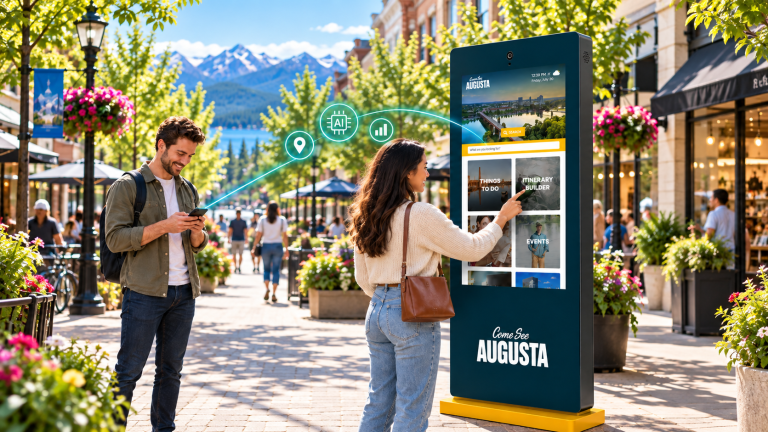
A Community Technology Ecosystem connects those experiences:
- Kiosque → Engage. Meet people where they are with information, wayfinding, businesses, events, attractions, services and AI.
- Mobile → Connect. Continue the experience on a person’s phone, saving places, discovering experiences, accessing services and staying connected.
- AI + Data → Understand. Make information easier to find, personalize the experience and understand what people are actually looking for and doing.
One ecosystem. One connected experience.
It Goes Beyond Tourisme
The Same Infrastructure Serves the Entire Community:
- Visitors. Discover businesses, attractions, events and experiences.
- Businesses. Reach people when they are deciding where to go, what to do and where to spend.
- Residents. Find information, services, events and resources more easily.
- Community Leaders. Understand engagement, demand and economic opportunity.
- And increasingly, Accesibility means language: People should be able to access community information in the language they are most comfortable using.
Amarillo, Texas provides a powerful example. Its AI digital human:
- Generated 16,800 website queries in its first eight weeks
- Achieved 98% user satisfaction
- Communicates in approximately 100 languages
- Has a projected $1.8 million in annual savings through better use of staff time
The lesson isn’t that every city needs the same technology.
The lesson is that AI can make community information easier to access, more inclusive and more measurable.
The Same Infrastructure Serves the Entire Community:
- Visitors. Discover businesses, attractions, events and experiences.
- Businesses. Reach people when they are deciding where to go, what to do and where to spend.
- Residents. Find information, services, events and resources more easily.
- Community Leaders. Understand engagement, demand and economic opportunity.
And Increasingly, Accessibility Means Language:
People should be able to access community information in the language they are most comfortable using.
Amarillo, Texas provides a powerful example. Its AI digital human:
- Generated 16,800 website queries in its first eight weeks
- Achieved 98% user satisfaction
- Communicates in approximately 100 languages
- Has a projected $1.8 million in annual savings through better use of staff time
The lesson isn’t that every city needs the same technology.
The lesson is that AI can make community information easier to access, more inclusive and more measurable.
Give City Leaders Numbers They Can Use
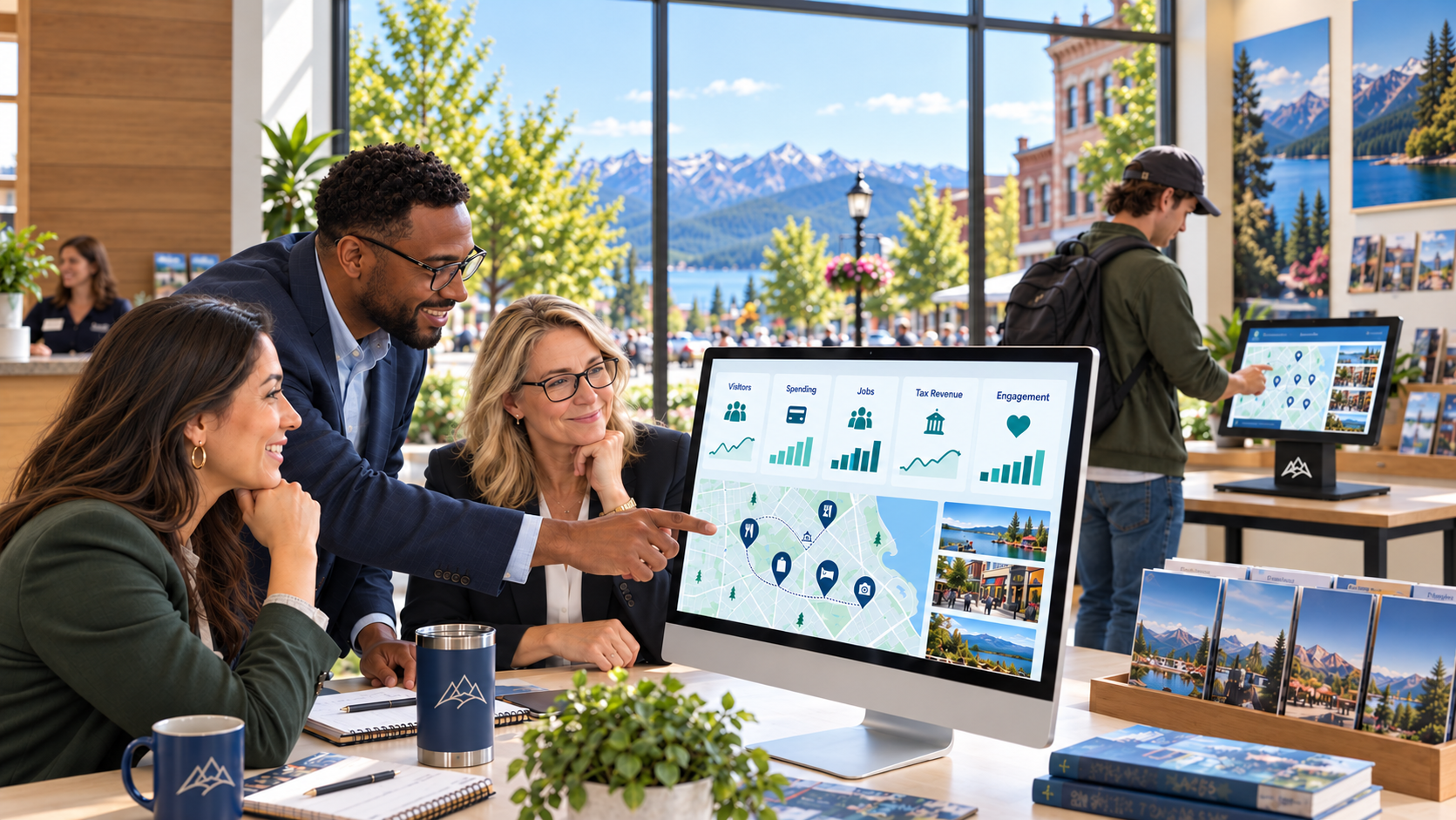
A DMO should be able to walk into a budget or board meeting and answer five questions:
- How many visitors do we attract?
- How much do they spend?
- How many jobs does tourism support?
- How much tax revenue does it generate?
- What are we doing to increase that value?
Those numbers turn tourism from a line item into an economic story.
And the opportunity is to go one step further. Instead of only measuring how many people came, communities can begin measuring:
- What did they look for?
- What did they discover?
- Which businesses did they engage with?
- What actions did they take?
- What economic impact can we connect to that engagement?
That is where technology becomes more than a visitor-information tool. It becomes community intelligence.
From Tourism Promotion to Economic Impact
The goal isn’t simply to attract more people. It’s to make every interaction more valuable.
More businesses discovered. More attractions visited. More events attended. More services accessed. More local spending. More data to help leaders make better decisions.
The journey is simple: See → Engage → Discover → Convert → Grow.
And it gives the DMO a stronger story to tell: “We don’t simply promote the community. We help connect people to it, and measure the value created.”
The Next Layer of Community Infrastructure
Cities have invested in physical infrastructure. They have invested in digital infrastructure.
The next opportunity is to connect the two.
The next opportunity is to connect the two.
Web. Mobile. Kiosk. Signage. In-Room. AI. Data.
Not as separate technologies, but as one ecosystem built around the people using them.
For DMOs, that means a stronger way to demonstrate their value. For businesses, more opportunities to connect with customers. For residents, easier access to information and services. For visitors, a better experience. For community leaders, better visibility into the economic and community value being created.
This isn’t about adding more technology. It’s about making the community easier to discover, easier to access and easier to understand.
The technology is the connection. The community is the value. Every Experience Starts Here.
Email us at info@trueomni.com or call 833-300-6664 and we will help your destination build that visitor connection.