For most hotel operators and ownership groups, strategy doesn’t fail in theory—it fails in execution.
Labor is tight. Margins are compressed. Guest expectations keep rising. And technology stacks keep growing without fully solving the core problems on the ground.
So when it comes time to invest, most hospitality leaders end up making one of three familiar choices.
Each one is rational. Each one is common. But only one actually changes how a hotel operates, captures revenue, and understands the guest experience in real time.
Choice A — Do Nothing (Operate the Existing Model)
This is the default in many hotel environments:
Keep the current operational structure in place:
- Existing PMS (Property Management System)
- Existing POS systems for F&B and amenities
- Manual or semi-manual housekeeping coordination
- Front desk-led guest communication
- Periodic reporting from revenue and operations teams
- Post-stay surveys and OTA reviews as the primary feedback loop
This is the “keep it running” model.
It is familiar, proven, and deeply embedded in daily operations.
Why hotels stay here
- Changing systems disrupts operations
- Training staff is time-consuming in high-turnover environments
- Margins make large-scale investment difficult to justify
- Leadership teams are focused on occupancy and RevPAR stability
So the model persists.
The hidden cost
The issue isn’t that it doesn’t work—it’s that it doesn’t see enough.
Most hotels are still operating with partial visibility:
- Guest intent is not tracked in real time
- Amenity interest is often missed or manually captured
- Service recovery happens after frustration, not during it
- Revenue opportunities are often lost in the moment
The operation runs—but it runs partially blind.
And in a labor-constrained environment, that blind spot gets more expensive every year.

Choice B — Add More Tools to Existing Operations (Efficiency Layer)
The second path is the most common investment cycle:
Add more systems to improve efficiency and reporting:
- Staffing and labor optimization tools
- Additional PMS/POS integrations
- CRM and loyalty platforms
- Guest messaging apps
- Revenue management systems
- Digital check-in / check-out tools
- Upsell and ancillary revenue platforms
This is the “optimize the stack” approach.
Why this is attractive
- Easy to justify ROI in isolation
- Solves specific operational pain points
- Improves reporting visibility
- Reduces some manual labor tasks
- Adds automation to fragmented processes
It feels like progress—and in many areas, it is.
The structural issue
Most hotel tech stacks optimize functions, not guest flow.
So you end up with:
- A system for booking
- A system for check-in
- A system for housekeeping
- A system for upsells
- A system for messaging
But no unified view of what the guest is actually doing inside the property in real time
So while efficiency improves, fragmentation remains.
And labor pressure doesn’t disappear—it just shifts.
Staff still have to interpret, connect, and execute across disconnected systems.

Choice C — Add a Guest Intelligence Layer (Operational + Revenue Layer)
The third option is not another tool. It is a connective layer across the guest journey.
Instead of adding more systems, it connects behavior across them.
This layer captures real-time, in-property guest activity such as:
- Amenity engagement signals
- In-stay purchase behavior
- Service requests and interaction timing
- Digital + physical touchpoint behavior
- Guest movement and interest patterns
The result is not more dashboards.
It is real-time operational awareness of guest intent.
Why this changes hotel performance
When hotels can see guest behavior as it happens—not after checkout—three things shift:
- Revenue becomes proactive instead of reactive
Upsell opportunities are identified during the stay, not after the guest has left. - Labor becomes more efficient
Staff allocation can align with actual guest demand patterns, not static schedules. - Guest experience becomes adaptive
Service recovery moves from post-complaint to real-time adjustment.

The Deeper Shift
Hotels have always had data—but it has been fragmented across systems and timeframes.
- PMS knows what was booked
- POS knows what was purchased
- Surveys know what was said after the fact
But none of these systems show: what is happening right now in the guest journey!
And that is where operational and revenue leakage happens.
The Real Decision
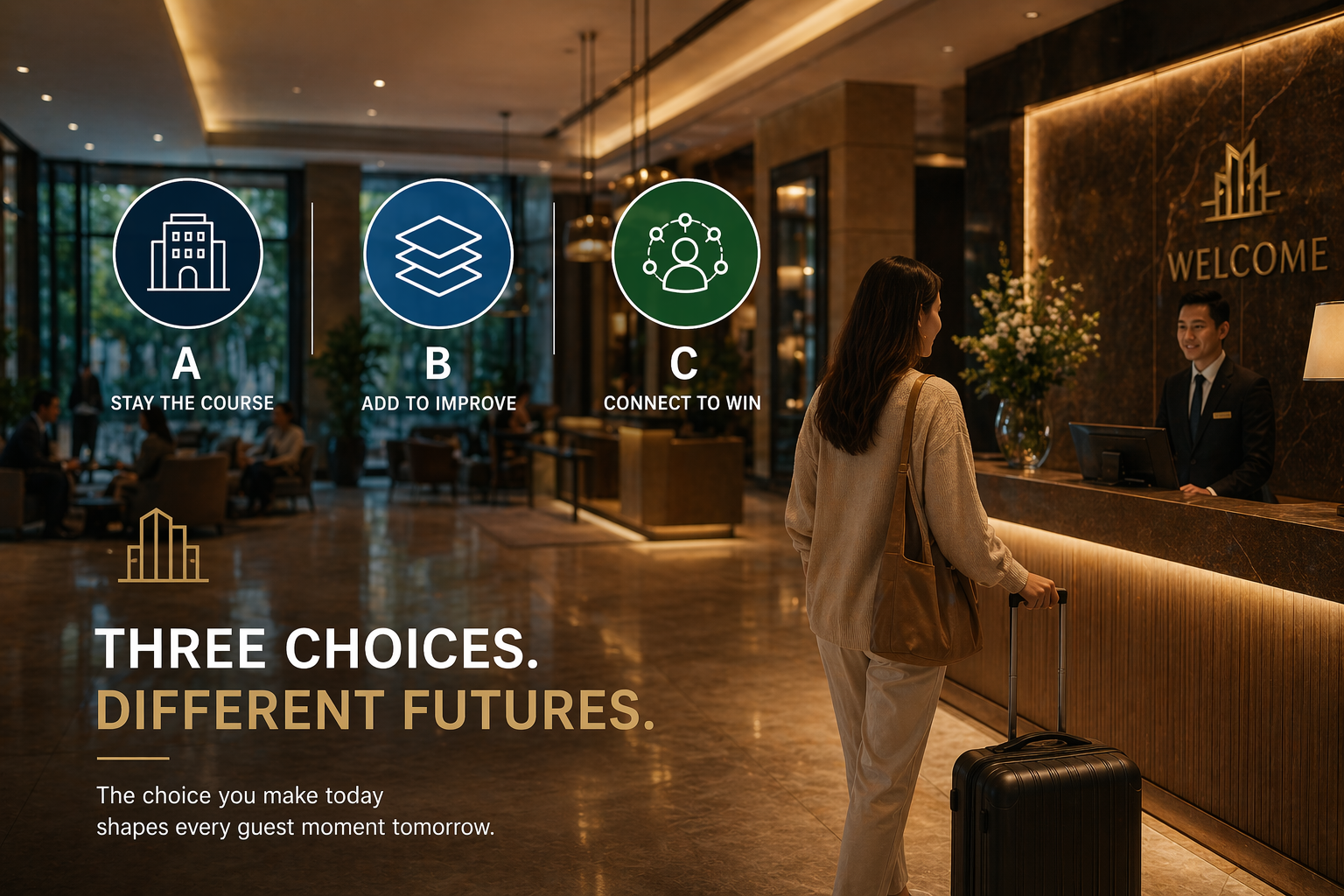
Every hotel is making a version of this choice:
- Stay with the current operational model
- Add more tools to improve efficiency
- Or connect the guest journey into a real-time intelligence layer
Choice A preserves stability.
Choice B improves function.
Choice C changes visibility—and with it, performance.
Because in hospitality, the difference between good and great is rarely effort. It is timing, awareness, and response. And those depend entirely on whether you can see what is happening while it is happening.
We help hotels bring this methodology to life, connecting guests, partners, and experiences into a measurable, sustainable ecosystem. Call us at 8333006664 or email us at info@trueomni.com.