TrueOmni connects every stage of the visitor journey starting at the gate into a single intelligence infrastructure that proves economic impact, funds itself through a destination media network, and gives DMO leadership the first-party data their boards, sponsors, and legislators want to see.
TWO AUDIENCES. ONE PLATFORM.
DMO directors need proof of impact. Sponsors need proof of return. TrueOmni is the infrastructure that produces both from the same visitor data.
Destination management organizations operate in a permanent justification cycle. Every board conversation, sponsorship renewal, and legislative appropriation draws from the same source: verifiable, first-party data about what visitors actually did at the destination. Most DMOs can only produce estimates — regional models, lodging tax trends, and visitor counts compiled after the season has already ended.
The organizations that win the next decade of budget cycles and sponsor renewals are the ones that know what their visitors are doing in real time, with attribution, from data they own — starting the moment a visitor lands.
TrueOmni is that infrastructure. It connects four physical touchpoints of the destination journey — airport, hotel, welcome center, attraction — into a single visitor intelligence layer that produces the proof both audiences need, from a platform that pays for itself.
THE DESTINATION VISITOR JOURNEY
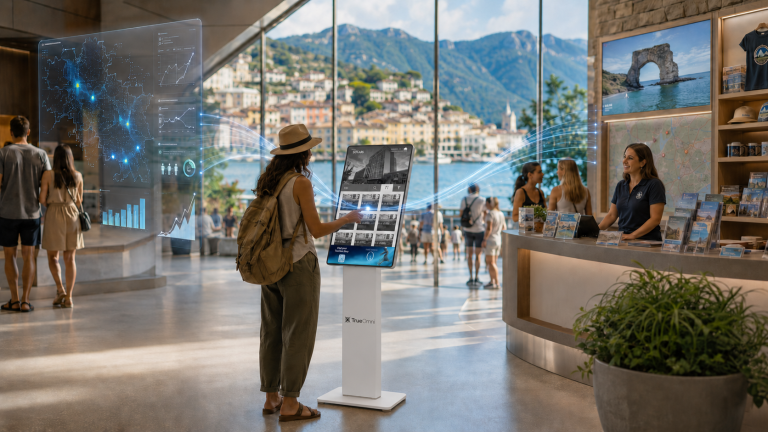
TrueOmni maps to the natural arc of a visitor’s trip — starting before they ever reach downtown. Each stage is a data capture opportunity, a revenue conversion moment, and a contribution to the economic case that gets stronger every quarter.
Stage 1 Airport & Transportation Hub The first touchpoint of the destination journey — ahead of the welcome center or the hotel. TrueOmni kiosks and digital signage at arrival gates, baggage claim, and transit hubs greet visitors in their language and capture origin and travel-intent data the moment they land. Nearly 8 in 10 travelers already want one smartphone experience for wallet, ID, and loyalty across their trip — and half have used biometrics in transit, with satisfaction at record highs. IATA, 2025 Global Passenger Survey AI kiosk & wayfinding · Secure Ready engagement · Arrival & origin data | Stage 2 Hotel & Accommodation For most visitors, the hotel is the next stop after arrival — and where they spend the most unstructured time in the destination. In-room devices, concierge screens, and mobile touchpoints extend the relationship and drive incremental spend before visitors reach downtown. Guest-facing technology has become a revenue driver, not just a convenience — most operators say it directly lifts revenue through upsells, and mobile checkout adoption keeps climbing. Hotel Tech Report, 2026 In-room engagement · Mobile checkout & up sell· Visitor profile deepening |
Stage 3 Welcome Center & Arrival Still the highest-intent moment in the journey — visitors who seek it out are actively planning their stay. TrueOmni kiosks, signage, and voice-enabled screens layer in what the airport and hotel already captured to sharpen every recommendation. AI kiosk · Digital signage · Voice AI | Stage 4 Attractions & Experiences At parks, museums, trails, and cultural venues, TrueOmni extends the relationship into the moments visitors are most emotionally engaged — and most likely to book, spend, and share. Experience upsell · Local discovery · Spend attribution |
The physical installations are the visible layer of the ecosystem. Beneath them, every device is a sensor capturing behavior, a channel driving conversion, and a data point building the first-party visitor profile that belongs to the destination not the OTA, not the brand, not the review platform.
HOW THE ECOSYSTEM CONNECTS
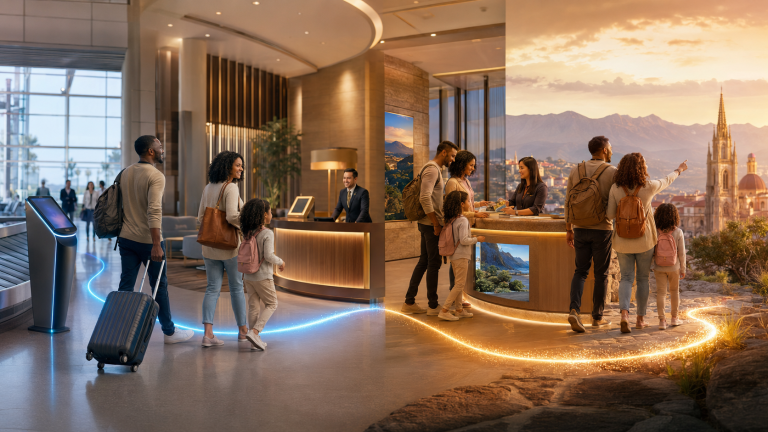
The three touchpoints don’t operate independently. They can share a guest information that updates in real time across the stay arc. What the mobile learns about a guest’s preferences, the lobby screen enforces brand, the Kiosk allows automated check in and upgrades. The lobby captures ancillary interest, the in-room tablet or QR engagement ensures the connection to events, things to do and upsells are provided consistently.
The four touchpoints Airport & transportation hub — First touch Hotel & accommodation — In-stay extension Welcome center — Arrival engagement Attractions & venues — Experience layer |
TrueOmni AI · Data · Media network |
What it produces
Visitor behavior — First-party profiles Economic proof — Attribution data Media network — Sponsor & ad revenue |
This connected architecture is what separates TrueOmni from a collection of kiosks. An isolated screen is a visitor service tool; the same screen inside TrueOmni’s ecosystem is a node in a destination-wide intelligence network.
CONNECTING TO WHAT DMOS ALREADY USE
Macroeconomic layer Tourism Economics, STIR Regional impact modeling, aggregate benchmarks, legislative reporting. Answer: how much did visitors spend? | Geographic layer Zartico, Adara, Placer.ai Mobility data, origin markets, geographic spend patterns. Answers: where did visitors go, and where did they come from? | Behavioral layer TrueOmni First-party engagement, real-time conversion, attributed economic activity. Answer: what did each visitor do, why, and what drove it? |
Together, the three layers answer what boards, sponsors, and legislators ask not just how much, but what drove it, who converted, and what would drive more.
THE DESTINATION MEDIA NETWORK
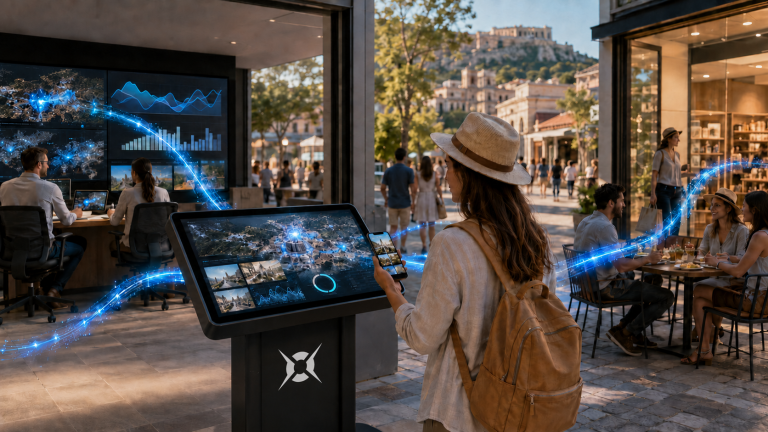
The destination that owns its visitor data owns a media network. That network is the business model that turns a DMO from a cost center into a revenue-generating institution.
First-party visitor data is a media asset. A destination that knows who its visitors are, what they respond to, and what they convert on has built the audience-targeting capability that regional advertisers, hospitality brands, and economic development agencies will pay for — across three revenue streams.
The TrueOmni destination media network Three revenue streams from one intelligence infrastructure |
Sponsor & advertiser network. Local businesses purchase featured placement with conversion data that proves impression-to-visit performance — not reach estimates. The DMO controls the inventory; sponsors pay for verified results. |
Economic development intelligence. State agencies and development authorities purchase access to real-time performance data as a live indicator that grounds traditional impact studies. First-party data commands a premium over modeled estimates. |
Destination content & commerce. The engagement platform becomes a booking layer for experiences and dining with the DMO earning a share of the commerce it generates instead of simply referring visitors elsewhere. “Whats Nearby” Google being the most popular. |
Becoming a revenue-generating institution isn’t incremental. It requires the connected engagement layer, the analytics that tie engagement to outcome, and the commercial relationships that monetize the audience the destination already has.
WHAT THE ECOSYSTEM PRODUCES FOR BOTH AUDIENCES
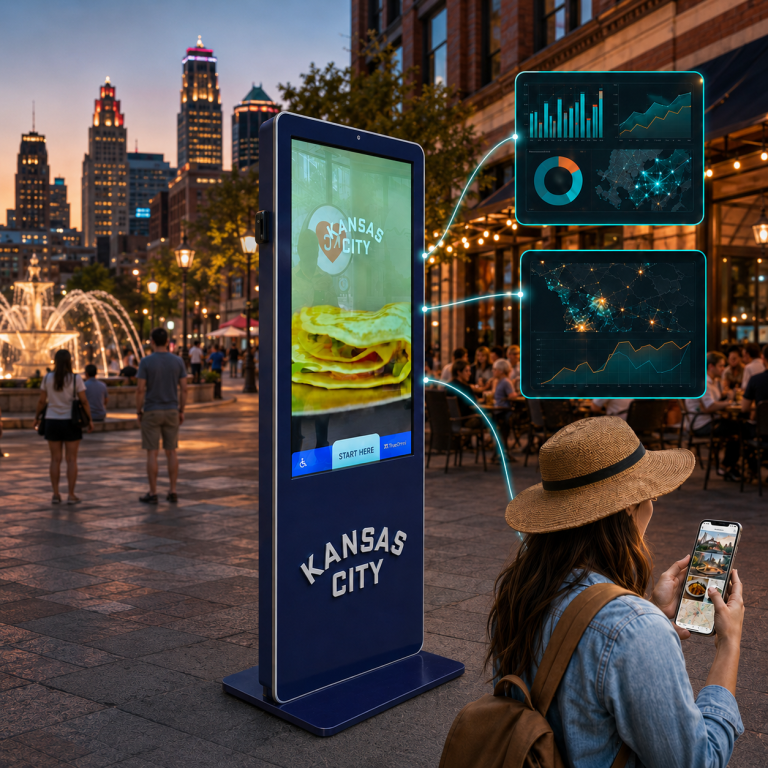
Every interaction across all four journey stages flows into one intelligence core producing four categories of output that serve DMO directors and sponsors simultaneously:
Visitor behavior profiles Who came, what they did, what they spent built from real interactions at every touchpoint. | Economic attribution Spend connected to specific engagements, not estimated from regional models. | Sponsor performance Verified impression-to-visit conversion data for every featured placement. | Trend intelligence Seasonal patterns, experience preferences, and emerging demand signals updated in real time. |
The destination that builds this infrastructure today isn’t making a technology purchase. It’s building a proprietary economic intelligence platform that proves its value every season and positions the DMO as the most data-credible institution in the room. Ed Spanok- CCO St Louis |
For the director: the evidence base for every board and legislative conversation. For the sponsor: verified conversion data instead of reach estimates. For the destination: a compounding intelligence asset that belongs to the place not the platforms.
Does your destination know what its visitors are doing
or only what they spent?
The difference between those two questions is the difference between a DMO that reports impact and one that drives it. To learn more, call 833-300-6664 or email info@trueomni.com